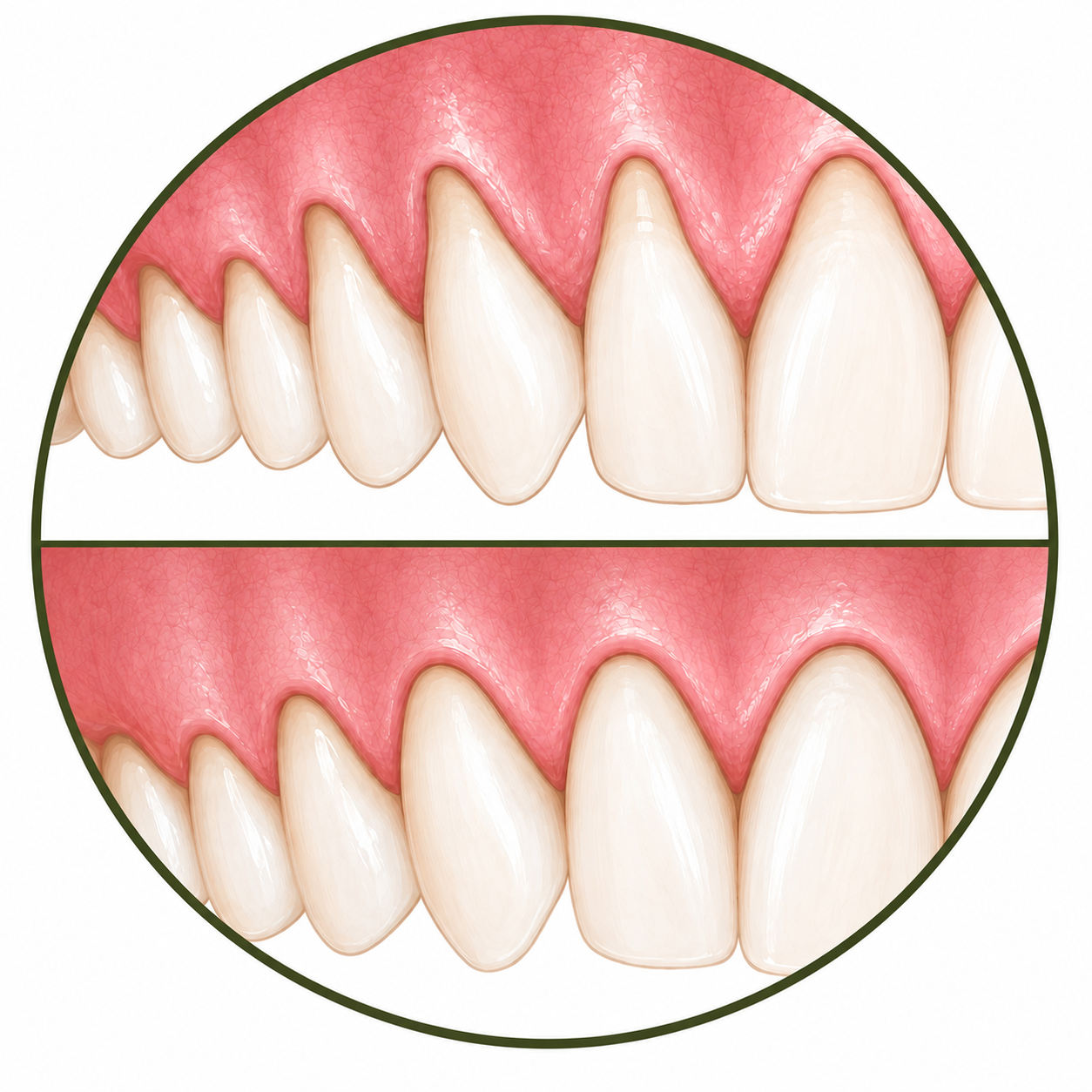
Protect Exposed Roots
Grafting may help protect vulnerable root surfaces where recession has occurred.
 Call to Schedule
Gum grafting
Gum grafting may address recession, protect exposed root surfaces, improve tissue support, and help create a healthier relationship between the teeth and gums.
Understanding gum recession
Gum recession occurs when the margin of the gum tissue moves away from its previous position, sometimes exposing part of a tooth root.
Periodontal disease, tooth position, thin tissue, brushing habits, anatomy, previous dental treatment, and other individual factors may contribute. An evaluation is needed to understand a specific site.
Why grafting may be recommended
Grafting is not necessary for every area of recession, and complete root coverage cannot be promised.
Grafting may help protect vulnerable root surfaces where recession has occurred.
Treatment may increase tissue thickness and support around an individual site.
A graft may be considered for appropriate areas of changing gum position.
Health, cleansability, stability, and tissue contours are considered together.
Soft-tissue expertise
Treatment is planned around the amount and quality of existing gum tissue, the location of recession, tooth position, and the desired long-term support. Depending on the site, a specialist may consider approaches such as connective-tissue grafting or tunneling techniques. Phenotype modification refers to increasing tissue thickness or quality where appropriate.
Our Newtown practice provides specialist-led soft-tissue care for patients from Bucks County, Greater Philadelphia, and nearby New Jersey.
Form + function
Periodontal plastic surgery considers tissue health alongside the relationship between gum tissue, teeth, and the overall smile. Esthetic and biologic goals are evaluated together without assuming that every site can or should be treated in the same way.
Designed for precision. Delivered with artistry.
What to expect
Technique and healing depend on the individual site and treatment plan.
We assess recession, tooth position, tissue quality, periodontal health, and individual anatomy.
The grafting approach is selected around the needs and limitations of the site.
The planned soft-tissue procedure is performed with attention to support and tissue handling.
The site is monitored as healing progresses according to the individualized plan.
Home care and professional maintenance help support periodontal health over time.
Gum grafting FAQ
Gum grafting is a soft-tissue procedure used to add tissue where recession or limited tissue support is present.
Contributing factors may include periodontal disease, tooth position, thin tissue, brushing habits, anatomy, previous dental treatment, and other individual factors.
No. Recommendations depend on the site, symptoms, tissue stability, periodontal health, and long-term concerns.
Root coverage may be possible in some situations, but the achievable result depends on anatomy, tooth position, tissue condition, and other site-specific factors.
Planning considers the amount and quality of tissue, location of recession, tooth position, periodontal health, and desired long-term support.
Healing varies by technique, site, individual biology, and extent of treatment. Your specific instructions and follow-up plan are reviewed with you.
Tissue position can change over time. Consistent home care, professional maintenance, and attention to contributing factors may help support stability.
It starts with you
An evaluation can help you understand an area of recession and whether gum grafting may be appropriate.
638 Newtown Yardley Road