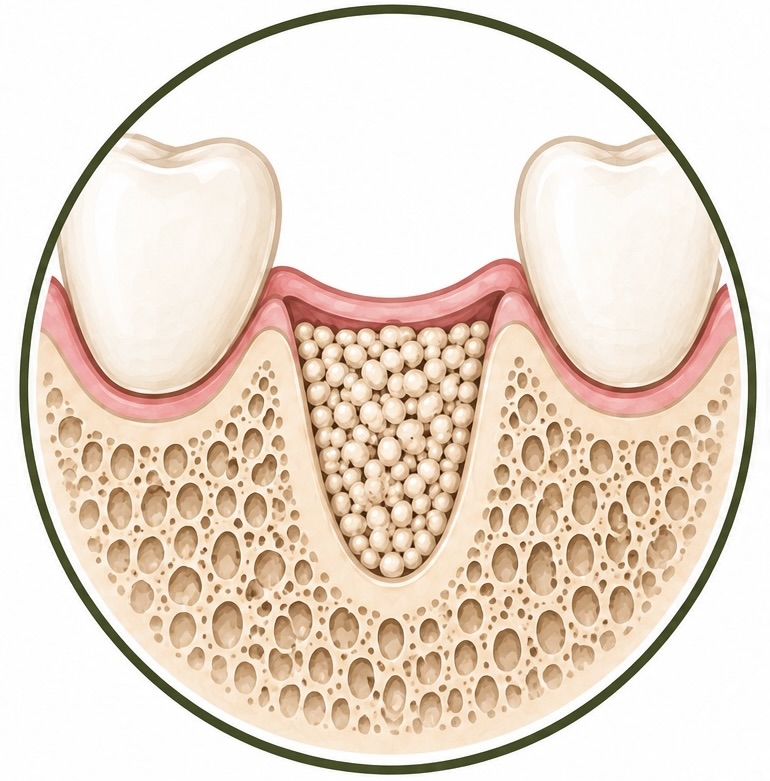
Site Preservation
Following tooth removal, grafting may help preserve bone in an area when appropriate.
 Call to Schedule
Bone grafting
Bone grafting may be recommended when additional bone support is needed to help prepare an area for dental implant treatment or support long-term oral health.
Understanding bone grafting
The jawbone supports natural teeth and dental implants. Bone volume can change after tooth loss, periodontal disease, previous infection or damage, and other oral-health changes.
Bone grafting is intended to rebuild or preserve bone where additional support may be beneficial. It is recommended only when the individual clinical and restorative plan calls for it.
Why bone loss can occur
Available bone may be influenced by natural anatomy, tooth loss, periodontal disease, previous infection or damage, and how long a tooth has been missing.
These factors do not determine treatment on their own. A careful evaluation is needed to understand the condition of a specific area and whether additional support may be appropriate.
Implant planning
Implant planning considers the final restoration from the beginning, helping guide decisions about implant position, bone support, anatomy, and surrounding tissue. Depending on available bone, grafting may be recommended before implant placement, at the time of placement in appropriate situations, or after tooth removal to help preserve an area.
When appropriate, this process may be described as site development or ridge augmentation.
Common situations
Bone grafting can serve different purposes within a coordinated treatment plan.
Following tooth removal, grafting may help preserve bone in an area when appropriate.
Additional bone support may be recommended before or alongside implant placement.
Treatment can help develop an area where bone volume has changed.
Site development may be one part of a coordinated restorative and surgical plan.
What to expect
The details and sequence are individualized following evaluation.
We review oral health, anatomy, imaging, and treatment goals.
We determine whether grafting is appropriate and how it relates to the complete plan.
The planned area is treated according to the patient’s individual needs.
The grafted area is given time to heal and mature as appropriate.
When grafting supports implant treatment, the area is reevaluated before moving forward.
Specialist care
Specialty bone grafting and implant site development in Newtown for patients throughout Bucks County, Greater Philadelphia, and nearby New Jersey.
Meet Our DoctorsBone grafting FAQ
Bone grafting is used to rebuild or preserve bone where additional support may be beneficial. The approach depends on the location, anatomy, and purpose of treatment.
An implant needs appropriate bone support and positioning. If available bone is limited, grafting may be considered as part of site development and the overall restorative plan.
No. The need for grafting depends on available bone, anatomy, implant position, oral health, and restorative goals.
In some situations they may occur together. In others, grafting may heal before implant placement. Evaluation determines the appropriate sequence.
Clinical evaluation and appropriate imaging help assess bone volume, anatomy, and the planned position of the implant and final restoration.
Healing varies with the location and extent of treatment, individual biology, and the overall plan. Your recommended sequence is reviewed with you after evaluation.
It starts with you
An evaluation can help you understand whether bone grafting may be appropriate as part of your treatment plan.
638 Newtown Yardley Road